The bad first page
I have a rule that the first page of anything I write is allowed to be terrible, and a record of what happens to it afterwards.
· 4 min read · 1,008 words
Every essay I publish starts with a page I would be embarrassed to show anyone. This is deliberate. I have a rule, written inside the cover of my current notebook, that says: the first page is allowed to be bad.
I came to the rule late. For about ten years I started each piece by trying to write a good opening, and I would spend an hour on three sentences. Then I would write the rest in a rush, relieved to be past the opening, and the rush showed.
What the first page is for
The first page is not an opening. I had that wrong for a decade. It is the place where I find out what I am actually writing about, which is usually not what I planned.
Last month I sat down to write about my grandmother’s sewing machine. The first page was about a sewing machine. The second was about the sound of the room it lived in. By page four, I was writing about the particular quiet of a house in the early afternoon, when everyone who lives there is somewhere else. The sewing machine became a small part of the finished piece.
the finished piece ran in March. The machine gets one paragraph, near the end.
If I had tried to write a good opening about the sewing machine, I would have written a good opening about a sewing machine. I might have been quite pleased with it. It would not have led anywhere.
Other people’s first pages
I am in good company, which is a comfort and not an argument. Balzac sent his novels to the printer half finished and rewrote them on the proofs, pasting new slips into the margins, until the typesetters, the story goes, would only take his pages an hour at a time.1
1 The proofs went back and forth many times, and printers charged him for every round of changes. On some books, it is said, the corrections cost him more than the novel earned. The page above is one of the gentler ones. The Morgan Library has the rest.
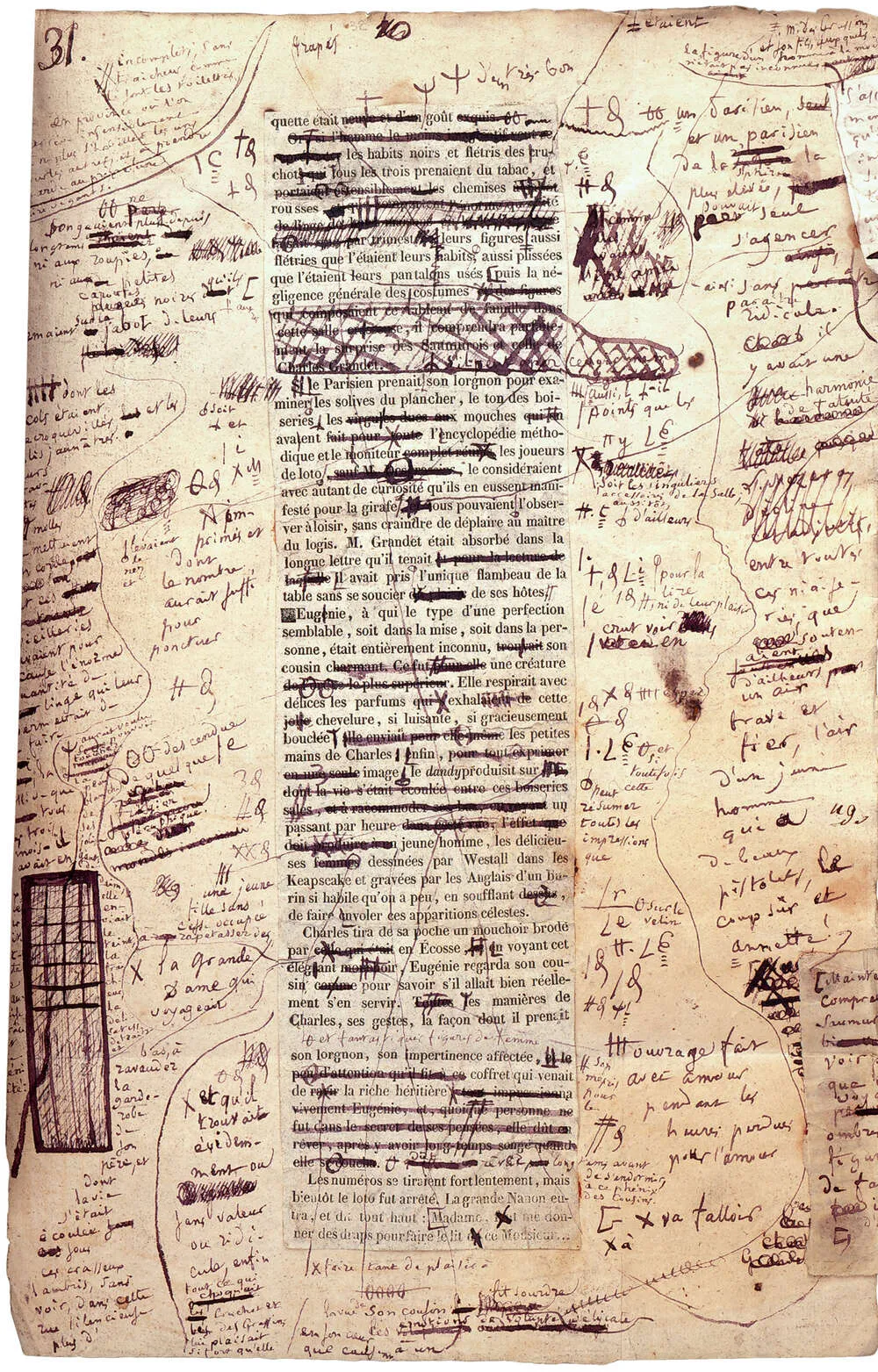
A page of Balzac’s Eugénie Grandet, 1833: the printed proof down the middle, his corrections everywhere else. The Morgan Library & Museum, public domain.
The first draft of anything is a way of finding out what you think. It is not yet the thing itself, and it should not be asked to behave like it.
— A note pinned above my desk, source long lost
The deletion ratio
I keep rough numbers. Of the last twelve essays:
| What happened to the first page | Essays |
|---|---|
| Cut entirely | 7 |
| Kept as a paragraph further down | 4 |
| Moved to the end | 1 |
| Survived intact | 0 |
The one I moved to the end worked better there than anything else I had written, and I felt I had been given a present.
That is a lot of throwing away, and I do not say it with regret. Cutting the first page is the cheapest edit there is. You do not have to agonise over a sentence you are about to delete. You only have to stand somewhere to start walking.
I used to believe that a draft should be a straight line, that good writers wrote forward and trimmed very little. I have met a few not met many of them. The ones I know write like they are digging, throwing dirt behind them and only later looking to see what they uncovered.2
2 A friend who writes novels told me she throws away roughly the first forty pages of every book. She says it with a cheerful shrug, as if describing a commute.
There is a small trap in all of this, which is that the bad page can turn into a place to hide. I know a person who has written four hundred first pages and finished none of them.
A bad page is only useful if a second page follows it, and a third, and eventually a reason to stop.
the passage I reread when I catch myself starting a fifth version of page one
A practical note
My method is almost too small to describe:
- Open a new file.
- Set a timer for twenty minutes.
- Write without stopping. If I do not know the next word, I write “something” and keep going.
- Do not read back. When the timer goes off, stand up.
The file starts the same way every time, so there is nothing to decide:
# (no title yet)

something
The “something” is more important than it looks. It stops me stalling on a word that is not the real problem. The real problem is nearly always three sentences earlier, where I said something I did not quite believe. I find it later, in the standing-up part, because by then I am no longer holding the sentence in my hand, and I can see it from the side.
Before the second draft I check the bad page against a short list:
- Did I find out what the piece is about?
- Is there one sentence I would keep?
- Does the opening still matter? (It almost never does.)
I should add that I do not always follow this. About one time in five, I write a decent opening on the first try and the whole piece comes quickly. I treat those as weather. They are pleasant and they say nothing about my skill.
What I tell people who ask
When people ask me how to get started, I usually say, write the worst version you can. It is the only advice I have that I have never had cause to regret. It also tends to be the advice that they find most irritating, since they were hoping for a trick.
There is no trick. There is a bad first page, and then there is the rest, and the rest has to come from somewhere.3
3 Sometimes I keep the bad page in a folder called compost. I have never gone back to it. I like knowing it is there.
Get the next one by email
New essays by email, about once a month. Nothing else.